By Thomas Davis, DNAP, MAE, CRNA
Evidence-based delivery of anesthesia is the foundation for our current practice as CRNAs. Going back four decades when I was an eager student in a hospital-based anesthesia program, the standard of care for general anesthesia consisted of nitrous oxide, opioids, sedatives, and volatile anesthetic agents. The goal was to deliver a hemodynamically stable patient to the recovery room and trust that the patient would wake up without incident. Because pulse oximetry had not yet been invented, visible breathing was all that was necessary, and we had no knowledge of oxygen saturation in the blood. Issues such as PONV and residual muscle weakness were treated by the PACU nurse as we moved on to the next case. We have come a long way since those early days in my career.
Fast forward to our current practice and the advancement of our profession to modern times where we are actively researching issues related to our practice and modifying the standard of care based on evidence. Among the modifications to current practice triggered by evidence is the shift to opioid-free anesthesia where possible.
Moving to opioid-free anesthesia
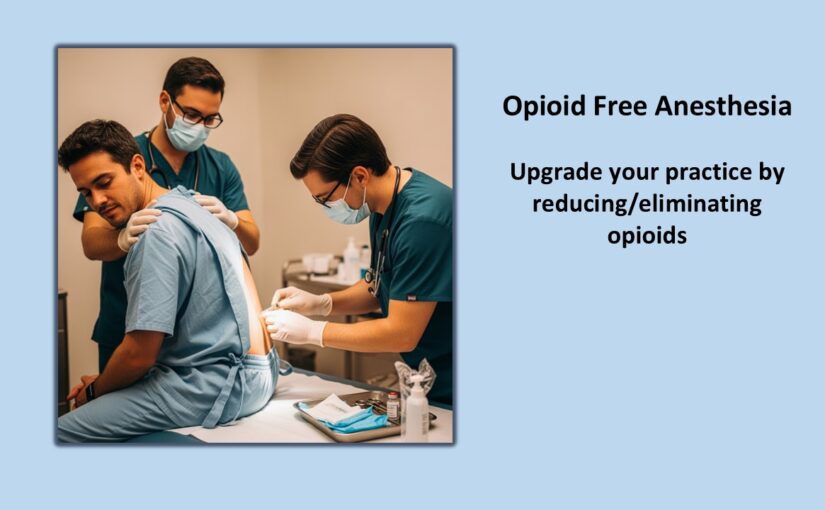
Historically, opioids have been integral to the administration of general anesthesia. However, evidence gathered over the past few decades has revealed that the use of opioids is not without risk and new alternatives to opioids have opened the door to opioid free anesthesia. To support the shift away from opioid use, the Society for Opioid-free anesthesia was established with the following goals:
- Summarize the existing literature on this anesthetic technique and provide evidence-based recommendations.
- Promote new research in this area of anesthesia.
- Educate and help guide anesthesia professionals as they learn about the transition to practicing opioid free anesthesia.
Those interested in learning more about the Society for Opioid Free anesthesia are encouraged to visit their web site, https://goopioidfree.com/
NIH supports moving away from opioid use
The National Institute for Health has the stated mission “seek fundamental knowledge about the nature and behavior of living systems and the application of that knowledge to enhance health, lengthen life, and reduce illness and disability.” After reviewing current research related to the use of opioids during anesthesia, the NIH lists the following as adverse side effects related to the use of opioids during anesthesia.
- Respiratory depression/apnea
- Hypotension
- Bradycardia
- Somnolence
- Confusion
- Urinary retention
- Constipation/ileus
- Increased intracranial pressure related to hypercapnia
- Rigidity
- Delayed emergence
- Delirium
- PONV
- Opioid induced hyperalgesia
- Development of long-term opioid abuse
The findings by the NIH reinforce the goals of the Society for Opioid Free anesthesia to move away from the routine use of opioids for anesthesia or analgesia in the perioperative period.
Why opioid free and why now?
The advancement of anesthesia practice requires that we modify our practice when new evidence emerges to support safer and more effective ways to achieve our goals. From a review of the literature, here are compelling reasons to move to opioid free anesthesia.
- Improved patient outcomes. Short term, there is less respiratory depression, nausea, and cognitive dysfunction in the recovery area. Long term, there is a reduction in urinary retention, constipation, pruritis, and cognitive dysfunction. In addition, there is evidence that certain types of cancer have a higher metastatic rate when opioids are used during removal of the primary tumor.
- Lower risk of opioid dependence. Opioid use can lead to an up regulation of pain sensation and the desire for even more opioids to provide relief. Over time, this may lead to long term opioid abuse.
- Enhanced recovery following surgery. ERAS protocols were initially developed to enhance recovery following bowel surgery and currently the protocols are being developed to include other types of surgery. At the core of the ERAS protocol is the elimination of opioids and the use of multimodal techniques for pain control.
Alternatives are available
Going back several decades, the alternatives to opioids had not yet been developed and anesthesia providers were obligated to use opioids as an adjunct to volatile agents when administering general anesthesia. Now, with the development of a variety of alternatives, the use of opioids is totally optional. When possible, the use of a nerve block with propofol sedation and multimodal supplements removes the need for opioids. Drugs such as dexmedetomidine, ketamine, acetaminophen and a variety of NSAIDS administered during and following a procedure provides adequate pain relief to the patient. Other supplements such as ice, gentile massage, relaxation techniques and gentle stretching add to the effectiveness of the multimodal approach. Preoperative teaching to educate the patient regarding realistic expectations and non-pharmacologic methods to alleviate discomfort further enhance the effectiveness of the multimodal approach.
Challenge yourself to go opioid free
Now is the time to challenge yourself to move away from the use of opioids in your practice of anesthesia and master the skills necessary for pain control without the use of narcotics. A quick search of the internet will provide a plethora of information about alternatives to opioids. For additional support, consider joining the Society for Opioid Free Anesthesia.
Tom is an experienced leader, educator, author, and requested speaker. Click here for a video introduction to Tom’s talk topics.