The Social Media Connection

By Thomas Davis, CRNA, MAE, Lt. Col (ret)

Follow @procrnatom on Twittersocial media post

Communication, collaboration and effective teamwork are essential ingredients for highly effective workplaces and insightful leaders must find creative ways to connect with the people on their teams.   Use of social media has been woven into an essential piece of the fabric that shapes our lives.  Rather than putting a ban on the use of electronic devices in the workplace, fire up your team by uniting them through social media.   Login and get stoked!


Event scheduling   Neither word of mouth nor notices posted on bulletins boards are reliable sources for disseminating information.  Online calendar apps, however, are abundant and many are free.    Instead of sending email schedules that require downloading, use an app and create a calendar that can be shared with your team.  Your community calendar will always be available for reference and posting a calendar removes the I-didn’t-know excuse.

  • Teamup is one of several apps that offer a platform to create a shared calendar. It offers sub-calendars, it’s simple to use and it’s free. https://www.teamup.com/apps/


Employee recognition   Employee contributions often exceed expectations and team members deserve recognition for their achievements.  In an ideal workplace the employee feels valued, appreciated and has a sense that he/she has contributed to the overall success of the team.  Follow up the hallway thank you with a brief post on social media to recognize each individual and each achievement.   Several social media platforms encourage the reader to forward the message to others in their network thus expanding the number of people who are notified of the success.

  • Open a twitter account and have your team members follow you. Tweet each achievement and encourage re-tweeting.   https://twitter.com/


Support   Teamwork is enhanced when people feel that they are part of a larger community and that they have the support of their peers.   Professional communities exist online that encourage individuals to connect with others who have the same credentials.  Members of a virtual community can pose questions, share experiences and learn from the collective wisdom of others in the same profession.

  • AANA connect is a private virtual community for nurse anesthetists and has sub-communities with different focuses. https://connect.aana.com/home
  • Facebook is the go-to platform for connecting friends and interfacing spontaneously. Within the Facebook platform, user groups have emerged to unite people with special interests. In the nurse anesthesia Facebook community, dozens of sub-groups exist for everything from CRNA moms to CRNA brewers.  https://www.facebook.com/


Team communication   Keeping up with your profession is helpful.  Communicating with your team is essential.  App based programs are readily available that allow your group to connect through text messages, providing instant communication for time sensitive issues.  This option requires each team member to download the app and join your user group, making the effort to connect worthwhile.  .

  • Groupme is a text-based app that provides all member instant alerts by “ping.” It’s free and easily downloaded.   https://groupme.com/en-US/apps


Video chat    When the crisis of the day arises and instant communication is imperative, live video chat is a great option.  Similar to SKYPE, LVC connects key members simultaneously for brainstorming and quick resolution.

  • Group video chat by Camfrog is an app that allows groups of people to connect via cell phone with live video and audio. https://www.camfrog.com/en/

Leadership requires powerful communication that effectively unites the team, and the most innovative leaders find creative ways to utilize social media in the process.   Younger members of your team who were raised with technology will feel right at home with social media while the senior members of the team will experience personal growth as they master the technology.  Everyone will be connected. Everyone will feel connected. Take an important step toward creating a workplace of choice by developing a sense of connectedness through the use of social media.

Thomas Davis is a noted speaker, author and team building coach.

“The book that goes beyond theory

and creates great leaders.”

Now available on Amazon Books

Be Thankful, It’s Healthy

Thankful postBe Thankful, It’s Healthy

By Thomas Davis, CRNA, MAE, Lt. Col (ret)

Follow @procrnatom on Twitter

Thanksgiving is over but it shouldn’t be.  A national day of reflection and giving gratitude is healthy for your mind and is also a great excuse to indulge in food, football and family.  Likewise, in a preferred work environment, insightful leaders create a healthy environment for their team members by being grateful and thanking them publicly and privately on a regular basis.

Writing in his book The Upward Spiral, author and neuroscientist Alex Korb connects being grateful with brain activity that elevates your mood.  The book goes on to offer tangible suggestions for alleviating depression.  High on the list of mood elevators is the act of being grateful which triggers the release of dopamine in the hypothalamus and creates a sense of wellbeing.  Even on a terrible day, the act of imagining things to be thankful for has the effect of elevating your mood.

Being grateful and giving thanks is as important in the workplace as it is in your personal life.  During a chaotic and stressful, pressure-driven day on the frontline, stopping to reflect on the positive events of the day breaks the anxiety cycle and shifts attention from problems to achievements.  In my book Leader Reader 1, Authentic Lessons in Leadership I recommend an end-of-day routine which includes reflecting on the activities of the day and giving thanks to those around you.  The activity has the double benefit of increasing your sense of wellbeing and ensuring that your team feels validated and appreciated.

In a contribution to Forbes.com, career coach, Nancy Collamer, offers the following tips for giving thanks in the workplace:

Just say it.  As you wind down the day, seek out people who have made a difference and give them a sincere thank you tailored to their contribution.  Walking through the work area and shouting, “Thank you everybody!” has very little effect.  Taking an individual aside and telling him/her “I really appreciate the work that you have done today.”, sends the message that you noticed and appreciated their effort.

Send an e-note.  It’s not always possible to see everybody face to face at the end of the day to affirm their work.  Sending a short email that thanks a worker for something specific that he/she has done is the next best thing to saying it in person.

Send a written card.  This old-fashioned method of giving thanks takes time and effort but sends a powerful message that the person is recognized, appreciated and worth the energy required to send the card.  Cards are appropriate when large projects have been completed or a person has sustained high performance over a prolonged period of time.  To make the card even more effective, send it to the person’s home address.

Recognition, reward and a sense of being appreciated are all elements of a workplace of choice.  Be grateful and give thanks to those around you to create a powerful double effect.  First, you will receive the benefit of changes in your own brain that elevates your mood and gives you a sense of wellbeing.  Second, you will reward those around you and take a step toward creating highly desirable workplace.  An intended consequence of giving thanks is that it is contagious and those on your team will follow your example by thanking one another when they collaborate to complete a task.

Be thankful, it’s healthy.

Thomas Davis is a noted leader, educator and leadership coach.

Start Tomorrow Today


Start Tomorrow Today

By Thomas Davis, CRNA

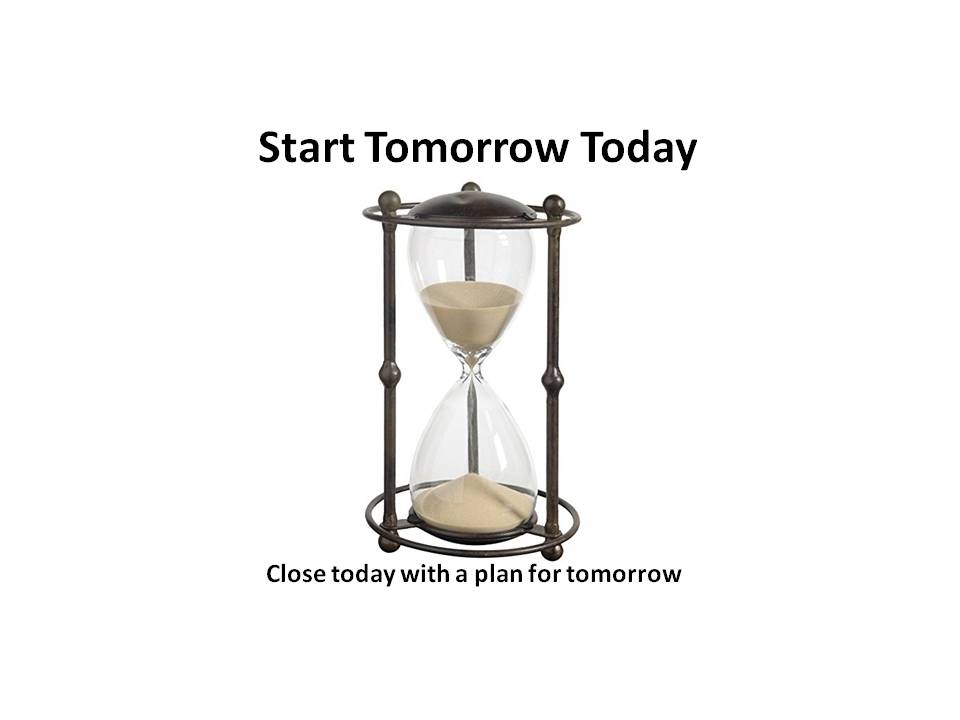
start tomorrow todayEffective leaders in healthcare, and across corporate America, are known for being very busy and efficient using effective schedules. Those who make it to the top leadership positions may appear to have everything under control as they progress through massive schedules. Although top executives have a support staff to help them maneuver through the day, their ability to navigate the workload goes beyond a skillful staff. CEOs have learned early in the game to establish a daily routine and weave it into it an agenda that the support team helps bring to life. An important component of the daily schedule is the end of day routine where the leader closes today and plans for a productive tomorrow.

Healthcare leaders work in an especially chaotic environment and by the end of the day it is tempting to pack up and leave. But if you skip out the door too quickly, you will deny yourself the opportunity to grow as a leader. The end of the day is a special time for you to reflect on the successes and challenges of the day, and to prepare for tomorrow. Leaders at any level will benefit by following these examples for routine and reflection.

• Block the last slot on your calendar for your shut down routine.
• Clean the clutter from your desk and your computer. Remove scrap paper and throw away everything that you do not absolutely need to keep. When in doubt, throw it out. Close any open files on your computer and reply ONLY to urgent email. Caution: Do not sacrifice your EOD routine by browsing through email and social media.
• Review the tasks on today’s to-do list and assess your effectiveness in bringing things to closure. Assess whether or not you were successful in completing your top priorities and determine which items to move to tomorrow’s to-do list.
• Close your eyes and visualize your biggest challenge. Relax and ask yourself WHAT questions such as, “What are other resources that I have not used?” “What if I re-prioritized my to-do list?” or “What piece of information is needed to allow the project to move forward?” Writing in the British J. of Psychology, Wieth and Zacks note that your brain is most creative when it is groggiest. Relaxing you tired brain and thinking through your upcoming challenges may give you insight that will solve tomorrow’s problem.
• Thank someone for their contribution to your personal success or the success of the team. Regularly recognizing others puts you and someone else in a positive frame of mind. In addition to showing thankfulness, sometimes offering forgiveness is important and appropriate.
• Review both your schedule for tomorrow as well as your to-do list. Make sure that your list reflects your priorities and that you have adequate resources to complete your list.
• Leave work at work and go home. On occasion you may need to finish something at home but routinely extending your work day into the evening will cause burnout and actually detract from your effectiveness.

Place value on your own after-work activities and develop the routine that works for you. To end my day with an established routine after leading a team of 110 healthcare workers, I created CROTE. Clean, Reflect, Organize Thank, Exit.

Building Common Purpose

Building Common Purpose

By Thomas Davis, CRNA

This is the third in a series of blog articles applying political quotes to frontline leadership. Previous articles have applied the words of Hillary Clinton and Mike Pence to frontline healthcare management. There is no intention of supporting or disparaging any candidate or party but rather learning from their words of wisdom. We will have to wait and see whether or not politicians and parties can turn words into action.

“You are the director of your own movie; if you aren’t enjoying what you are doing, change it.” “Stand up for principles and offer a real alternative.”   Gary Johnson


team buildingSame stuff, different day. Is that your experience as a frontline leader and manager?   Going back a few years, the basic murder mystery was the backbone of evening television.   A crime was committed, several suspects were identified, surprise evidence emerged, and the bad guy was caught.   The format was predictable, however in 1971 “Columbo” reversed it. A crime was committed with the perp identified up front. Viewers were kept on the edges of their seats while alibis melted away until justice prevailed.

To enable your group to achieve excellence and to keep the job interesting, rewrite your daily script. Engaging your team to edit the script creates a common purpose and becomes the cement that binds the team

Develop a common purpose.   If you think you have problems building consensus and motivating a team, consider the challenge faced by Coach Mike Krzyzewski when he agreed to coach the Olympic men’s basketball team. Taking a group of millionaire all-stars and asking them to give up their summer vacations in order to play even more basketball was not an easy task. To be successful, the team needed a common purpose.   Coach K took the team to Arlington Cemetery and the tomb of the Unknown Soldier and talked about people giving their lives for their country. He then took the team to the area of the cemetery where recent casualties are buried and they viewed gravestones of people younger than they. He arranged workouts at the military academies where young people were preparing to give all for their country if necessary. When all was done, the team was no longer playing summer basketball; they were playing for the honor of their country and all those who have given their lives to defend it. They had a common purpose.

As a frontline healthcare leader, you most likely will not be able to take your workgroup on a field trip to a National monument. Therefore, you must find common purpose within the environment where you live and work.

Create a common purpose

  • Focus on patient safety and satisfaction when rewriting the way you conduct your business.
  • Openly discuss concerns and explore remedies
  • Actively listen to each member of the team as they offer fresh ideas
  • Have a former patient or family member talk to your team and tell their story


Change the Script. As a leader, the team looks to you for guidance and wants you to motivate and provide direction. Be bold and confident when interacting with your team.   Meet regularly and link the new script to each member personally.   Tie common purpose to a sense of urgency and role model the new behavior that is expected of the group

Implement Change

  • Display competence and confidence when sharing expectations
  • Clearly outline expectations as you role model the desired behavior
  • Actively listen to and address concerns of team members. Ask what it would take for them to be fully on board.
  • Establish benchmarks to document progress toward achieving the larger goal
  • Recognize and reward desired behavior.


Some tasks have to be repetitive, but no one enjoys watching the same movie day after day. As a frontline leader, you will improve the workplace for both patients and workers by making a new script that infuses energy and improves outcome.


Thomas Davis is an experienced clinical anesthetist, leader, speaker and the owner of Frontline Team Development and Leadership.

Leading Frontline Change

Leading Frontline Change:

Today’s leadership investment yields tomorrow’s team dividends

By Thomas Davis, CRNA

Effectiveness as a leader is not based on popularity but rather on the ability to manage change

FLA“The only constant is change.”    Modifications to best practice protocols are initiated internally and are meant to improve both workflow and patient outcome. Other initiatives have an external source and are mandated by new regulations or alterations in reimbursement.   Frontline managers and team leaders set the tone for how the work group will respond and the attitude projected by the leader will ultimately contribute to the success or failure of the initiative.   Frontline Leaders are critical to success whenever the status quo is altered.

As recently as 5 years ago, in order to accommodate the need for Nurse Anesthetists and ICU nurses to work 12-hour shifts, several hospitals offered workers 3 X 12 hours per week to count and be paid as a 40 hour work week. The response was positive and the hospitals had a plethora of applicants working the popular shift.   Over time, changes in healthcare reimbursement took place and the 36-paid-as-40 model was no longer viable. Hospitals were forced to implement new schedules that required 40 hours of work for 40 hours of pay. For example, two individual hospitals in the same community implemented the change to the 40-hour work week with very different results.   Although the change was not popular at either hospital, one system made the change smoothly with the team focused on all of the other positive benefits offered by the employer. As a result, there were no resignations. At the second hospital, 18 members of the department abruptly quit their jobs. The difference was Frontline Leadership.

Status quo does offer a level of comfort, however, change is often an opportunity for the frontline healthcare leader to experience personal growth as well as growth and development of the team. The leader’s personal response to the change will set the tone for the entire workgroup. By using asset based thinking (ABT), creativity and good communication, your workgroup can lead the way in the implementation of change.   Remember, change does not necessarily threaten your personal vision. With creativity, change can actually move your vision forward. In the example of implementing the 40- hour work week, the successful leader held true to the vision of making the hospital an employer of choice.   The reason behind the change was thoroughly explained to the workgroup and the implications were revealed.   The group learned that the change would bring financial stability to the organization and add security to their jobs. The group actively participated in creating a new schedule that was acceptable to all. When the change was made, even though they preferred the 36-hour work week, the change went smoothly.   Conversely, at the other hospital the change was implemented as a mandate from above. The attitude was, “if you don’t like it, find another job”…and many did.

Build on a solid foundation  

Change is commonly perceived as threatening when the frontline worker sees no personal benefit.   Strong leaders have an opportunity to thrive during times of change as opposed to weak leaders who wilt and eventually perish. Leaders who are successful at embracing and implementing change are people who have a long history of being connected with the workgroup. A leader may safely assume that at some point policies and procedures will be altered. Establishing yourself as a trusted and confident person who cares about each team member on a personal level will give you credibility with the team when they feel threatened by the need to modify the status quo.

To be an effective leader:

  • Role model excellence in every phase of the job. Take your turn on the front line of patient care along with the members of your workgroup and earn respect for your skills.
  • Develop a one on one relationship with each member of your team. Know something personal about each person and have a sincere desire to promote their professional development.
  • Have a vision for the group and communicate it regularly. Every member of your team must know and support your vision.   Encourage open discussion to clarify your vision.
  • Be upbeat and confidently demonstrate ABT.  Anticipate success.


Do your Homework

With change comes anxiety and when people are uncertain, rumors emerge.   You will be amazed at what a friend of a friend heard someone say in the elevator.   Once gossip takes on a life of its own, it will taint how we perceive people and problems. Writing in Science, Eric Anderson states, “Gossip does not impact only how a face is evaluated – it affects whether a face is seen in the first place.” Once the gossip starts, time is of the essence to get it stopped. A leader must quickly understand the proposed change and the reasoning behind it, connecting the new policy to the greater goal of the organization, and then communicating it honestly and openly.

Before you talk with your team about the upcoming change, become the expert on the topic. Read the new policy and have a one-on-one conversation with your superiors and other stakeholders. Succinctly share your concerns privately in a proactive and asset-based manner.   Always speak and listen with good intent and with a commitment to understand.

Before you meet with your team:

  • Clarify the specifics of the future state and the advantages that will emerge with the new policy.
  • Identify and utilize key stakeholders and sources of support.
  • Identify obstacles and explore ways to remove them.
  • Involve key people in the workgroup to help with the rollout of the new plan.
  • Develop a timeline and abide by it.   Delaying will only give more time for rumors and gossip to spread.


Communicate

Sincere, two way communication is essential for implementing and managing change.   Set a positive and confident tone when discussing the future. If members of your team perceive that you are uncertain and lack confidence, they will not openly support you. Your ambivalence will be compounded by the negative effects of rumors and gossip causing morale to drop along with the effectiveness of your leadership. Now is the time for you to display self-assurance and maintain control. Being recognized and respected as a leader is status that is earned over time. From day one a leader must earn the trust of the team. Once you have done your homework related to the change and you know the details of both why and how the change will be implemented, you are ready for one of the most important roles of a leader – keeping the team informed.

To keep the team informed:

  • Schedule a town hall meeting where the change can be openly discussed.
  • Be open and honest and share all that you have been asked to share. If you have been asked not to share something, don’t pretend that you don’t know. Simply state that you cannot yet share that detail.
  • Let people know that gossip is not acceptable(will not be tolerated?). Honestly answer all questions in order to prevent and dispel rumors.
  • Listen to each member of the team with the intent to understand. Acknowledge individual concerns.
  • Use ABT to focus on positive aspects of the change.
  • Where possible, connect the proposed change to your personal vision and the greater goal of the organization.
  • Challenge the team to actively participate with implementing the change.


As the leader of a team of frontline healthcare workers, you want everything to run smoothly on a daily basis with great workflow, safe patient outcome and a happy staff.   Although change can be challenging to the team, it can also be an opportunity for the talented Frontline Leader to shine.   Make a commitment to establish a solid foundation with your team and to connect with each individual. The groundwork that you lay today will pay huge dividends when it’s time to implement the inevitable change.

Thomas Davis is an experienced clinical anesthetist, leader, speaker and the owner of Frontline Team Development and Leadership.